Adaptable Curricular Exercises (ACE) for Quantum Information Science (QIS)
Research-based QIS instructional resources to support faculty, including those new to these topics, aiming to incorporate more active learning elements in their classes.
We have materials for two different audiences, depending on the type of course you teach:
QM Course: Are you teaching quantum mechanics in a physics department to (mostly) majors, and want to add a short unit on quantum information (e.g. quantum computing or cryptography) within your course?
QIS Course: Are you teaching a quantum computing/QIS course to students from a variety of majors (e.g. computer science, physics, engineering, math, etc.), and want materials for foundational topics?
And: if you teach undergraduate quantum mechanics to physics students and are looking for a suite of student-centered materials to help you with the entire QM course, please visit our Adaptable curricular materials for Quantum Mechanics site.
Introductory Quantum Information Science Materials
Who is this for? These materials are for anyone teaching an introductory (first course in) quantum computing or quantum information science.
Why did we create these materials?
- To assist faculty aiming to incorporate more active learning elements into their classes.
- To support students from multiple different academic backgrounds (e.g., physics, computer science, engineering, math, chemistry, etc.)
Why these topics? We focus on just a few fundamental ideas in QIS. Some students may find these materials too easy, while others may find them too hard. That is exactly the reason for their existence! The goal is to provide students with deep conceptual practice, allowing all students to reach a level of understanding that will set the foundation for future QIS learning.
What will you find here?
Tutorials
 These interactive worksheets are designed for students to work through in small groups during class. Learn more here.
Links to online versions of the tutorials
These interactive worksheets provide students with real-time feedback as they practice. They can be done independently by students outside of class.
Clicker questions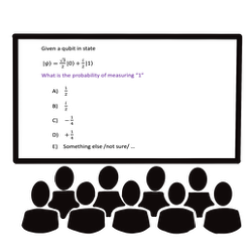
These conceptual questions can make your lectures more interactive.
 Introduction to Quantum Gates
Content: Superposition states, single-qubit gates (X, Z, H, and I), Dirac and matrix notation, measurement probabilities, and single-qubit X, Z, H, and I gates.
Prerequisite knowledge: None. However, previous classroom introduction to basic ideas and notation of quantum states (including Dirac and matrix notation) is useful.
Faculty notes: Content to get started and tips for teaching.
If computers that you build are quantum
then spies everywhere will all want ‘em.
Our codes will all fail
and they’ll read our email,
till we get crypto that’s quantum, and daunt ‘em
- Jennifer and Peter Shor
This first subunit involves a brief introduction to QIS: quantum information science. An introduction to the big ideas of quantum information and quantum computing serves to motivate the upcoming topics. Some discussion of the "hype" vs realities of QIS might be in order here. A little background in classical computers may be relevant (note that some are discussed in the "Parts of a computer" section below)
Classical computers store, process, and manipulate bits (characterized abstractly as 0 or 1). Current optimal algorithms for factoring large numbers take time that grows exponentially with the size of the number to be factored, and current commercial encryption takes advantage of that fact. If one were to have functioning quantum computers that could store and manipulate quantum bits (i.e., superpositions of 0 and 1 - which we will discuss shortly), there exists an algorithm (Shor's) that could "decrypt" current common protocols exponentially faster. This has generated excitement and hype, and there are major efforts in industry and academia to construct such machines and develop new algorithms. A key aspect of quantum computing is the concept of "basis size" - for a 4-bit quantum computer, a given stored qubit can be a superposition of up to $2^4 = 16$ basis states. In some sense, this represents exponentially more information in a single qubit than the 4 bits a classical computer stores.
This is a (brief) introduction to qubits (including Dirac notation) and superposition. For students with a with a physics background, this is intended to make the quick shift from more general quantum observables to 0's and 1's.
Bits in a computer (or, as we’ll refer to them, classical bits in a classical computer) are 0 or 1. The distinction between a bit and a quantum bit, or qubit, is that a qubit can be in 0, 1, or a superposition of 0 and 1.
If you measure a qubit, it can only have one of two different values: 0 or 1 (just like a classical bit). But before measurement, it can exist in a superposition of 0 and 1.
Mathematically, we write $ | 0 \rangle = \begin{pmatrix} 1 \\ 0 \end{pmatrix}$ and $ | 1 \rangle = \begin{pmatrix} 0 \\ 1 \end{pmatrix}.$
These qubit states form a basis in the two-dimensional Hilbert space (complex vector space). A key difference between the discussion of measurement in quantum computing vs other areas of quantum mechanics is that we do not discuss observables but rather only talk about measuring a “0” or a “1”. In contrast, if we were talking about measuring the spin of an electron, I would talk about measuring the $S_z$ (or spin in the z-direction) and getting a value of $\pm \hbar/2 $. When building a quantum computer, it is important to discuss the physical system realizing the qubit and what observable is being measured, but for our theoretical discussion of quantum states, we will refer to it simply as measuring "0" or "1".
The basis created by $|0\rangle$ and $|1 \rangle$ is called the "computational basis" or the "standard basis".
The general state of a qubit can be written as $a|0\rangle + b|1\rangle$, where $a$ and $b$ are complex numbers (they are the probability amplitudes) and we require that $|a|^2 + |b|^2 = 1$ .
For this general qubit state, the probability of measuring a 0 is $|a|^2 $ and the probability of measuring a 1 is $ |b|^2 $.
Classical computers work with bits, denoted by states 0 or 1. The physical implementation of those bits is rather arbitrary (typically low and high voltage on a wire), but for many practical computing purposes also irrelevant. The same will be true for quantum computers, but now the qubit can be in any superposition state $a\ket{0} + b\ket{1}$.
Classical computing requires gates: operators that act on a bit (one or more) and output a resulting bit. The "Not" gate is the simplest single-bit gate: inputing a 0 yields a 1 and vice versa. This can also be thought of as a logic operation (interpret 0 = "false" and 1 = "true") The "And" gate acts on 2 inputs and returns a single output, the logical "And" operation.
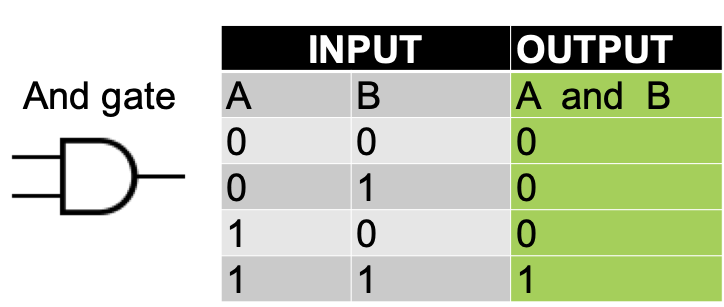
Quantum gates similarly take input states, act on them, and produce output states. The final stage of a set of quantum operations will ultimately be a measurement, but the sequential operations should not make any measurements (indeed, avoiding such collapse of the quantum superposition state is a major engineering challenge at the moment). Schematically, the process can be thought of schematically like this: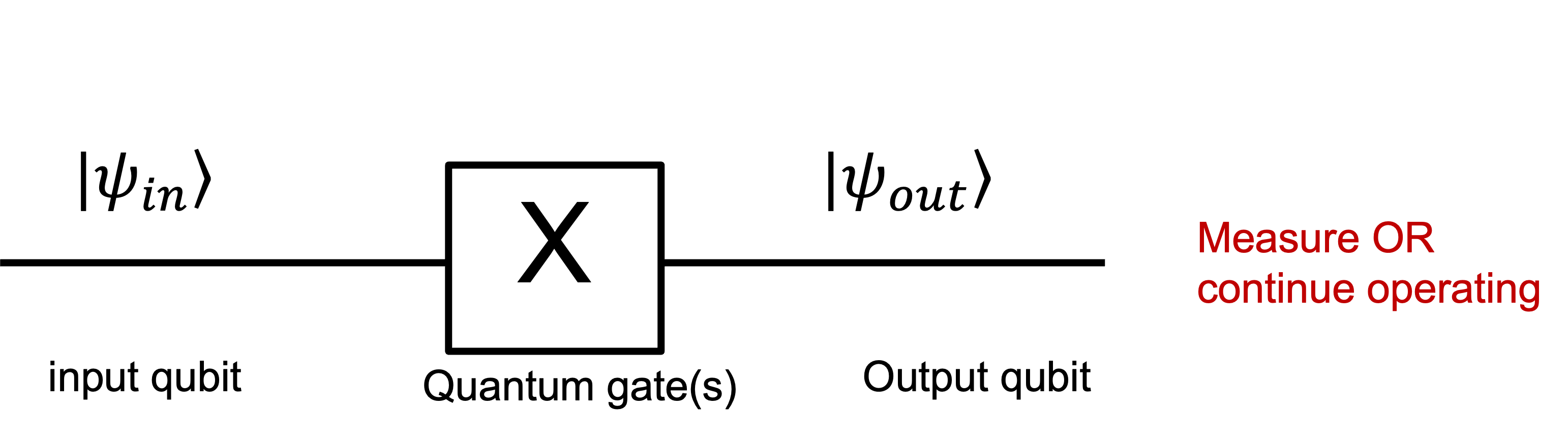
Much current physics and engineering research is devoted to studying how to physical implement qubits - examples include spin-1/2 systems where 0 and 1 represent "up" and "down" spin in the Z direction, and certain gates could involve applied magnetic fields (for instance), but the states could also be photon polarization, energy levels of trapped atoms, current in Josephson junctions, or many more. For discussing gates and algorithms, just as with classical bits, this physical implementation is not essential.
A quantum gate is an operation performed on qubits. Mathematically, gates are associated with unitary and linear operators. Linear means e.g. $Z(a\ket{0} + b\ket{1}) = aZ\ket{0} + bZ\ket{1}$. Thus, one way to define them is by their operation on computational basis states.
- $X$-gates: $X\ket{0} = \ket{1}, \ \ X\ket{1}=\ket{0}$.
(The $X$-gate is a 'bit flip' or NOT gate: taking $\ket{0}$ to $\ket{1}$, and vice versa. ) - $Z$-gates: $Z\ket{0} = \ket{0}, \ \ Z\ket{1}=-\ket{1}$.
The $Z$-gate is thus sometimes called a "phase gate" (flipping the phase of $\ket{1}$ states.) - $Y$-gates: $Y\ket{0} = -i \ket{1}, \ \ Y\ket{1}=i\ket{0}$.
The $Y$-gate is thus a combination of the previous two ($Y = iZX$). - Identity ($I$): $I\ket{0} = \ket{0}, \ \ I\ket{1}=\ket{1}$.
The identity operator $I$ does not alter input states in any way. - Hadamard gates:
$H \ket{0} = \frac{1}{\sqrt{2}} ( \ket{0} + \ket{1}) \;\; \text{ and } H\ket{1} = \frac{1}{\sqrt{2}} ( \ket{0} - \ket{1})$.
The Hadamard is a common and useful gate in quantum computing algorithms - it converts pure computational states into superposition states.
Note that $ XX = YY = ZZ = H H = I$, and that order matters, e.g. $X$ does not commute with $Z$.
So e.g. $a\ket{0} + b \ket{1} \doteq \begin{pmatrix} a \\ b \end{pmatrix}$ (with $\doteq$ read "is represented by")
In this representation, the most common gates are akin to the Pauli operators:
$ X\doteq \mqty(0 & 1 \\ 1 & 0), \;\; Y \doteq \mqty(0 & -i \\ i & 0), \;\; Z \doteq \mqty(1 & 0 \\ 0 & -1) \;\; \text{ and } I \doteq \mqty(1 & 0 \\ 0 & 1)$
The Hadamard gate is $H \doteq \frac{1}{\sqrt{2}}\mqty(1 & 1 \\ 1 & -1)$.
A natural follow-up is to ask the same question for $H\ket{0}$. These questions provide elementary practice and serve as conversation starters. $H$ plays a huge role in algorithms: often the first step is to start with a bunch of $\ket{0}$ states, then act $H$ on each to get a collection of superposition states.
Downloadable materials:
- Activity: Introduction to Quantum Gates (1A)


- Instructor's Guide
- Clicker questions

- Warm-up (pre-test) for Intro to Quantum Gates
Online tutorial:
We have developed a series of online tutorials that students can complete in class (alone or in groups) or at home. These materials are hosted on our website. To get a course page where you can access student completion information, email us at hello[at]acephysics[dot]net.
Online Tutorial: Introduction to Quantum Gates
Quantum Circuit Diagrams
Content: Practice with single-qubit gates represented as circuit diagrams.
Prerequisite knowledge: Basic gates and quantum states. (This can all be found in the previous tutorial, "Introduction to Quantum Gates.")
Faculty notes: Content to get started and tips for teaching.
Circuit diagrams use lines to indicate individual qubits and boxes to indicate quantum gates. They are read from left to right. The following diagram depicts the equation: $\ket{\psi}_{out} = X Z \ket{\psi_{out}}$.

Note how the equation looks "backwards" compared to the circuit, but it is clear in both that the $Z$ gate acts first. We can also depict a measurement by using a symbol of a "meter" as shown below (note that different textbooks often have different conventions for a measurement symbol).
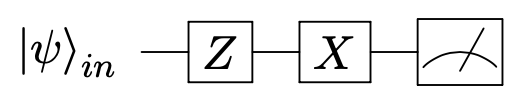
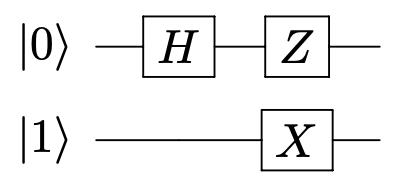
When we add additional qubits, they are shown as additional lines where the top line is understood to be the first qubit. The circuit diagram below shows the output for the first qubit is $ZH\ket{0}$ and the output of the second qubit is $X\ket{1}$.
Downloadable materials:
- Activity: Quantum Circuit Diagrams (1B)
- Instructor's Guide
- Clicker questions
- Warm-up (pre-test) for Quantum Circuit Diagrams
Online tutorial:
We have developed a series of online tutorials that students can complete in class (alone or in groups) or at home. These materials are hosted on our website. To get a course page where you can access student completion information, email us at hello[at]acephysics[dot]net.
Tensor Products
Content: Helping students describe systems with multiple qubits.
Prerequisite knowledge: Students should be familiar with quantum states, basic single-qubit gates and circuit diagram conventions. (i.e., The sections above, on this page.)
Faculty notes: Content to get started and tips for teaching.
When moving to N-qubit systems, the dimensionality of your basis grows as $2^N$. Here we briefly introduce students to the ideas of combining two single particle states into a larger-dimensional 2-qubit state, and how to represent this in Dirac (or matrix) notation, using the language of tensor products.
There is only so much that can be done with a single qubit. To add a second qubit, we use the tensor product $\otimes$. If the first qubit is in the state $\ket{0}$ and the second qubit is in the state $\ket{1}$, then the two-qubit state can be written as $\ket{0} \otimes \ket{1}$. There are several shorthand ways to write this. Below are all equivalent formulations:
$ \ket{0} \otimes \ket{1} = \ket{0} \ket{1} = \ket{01}$
For brevity, the last one is most commonly used unless it is important to emphasize the states of the individual qubits, in which case the $\otimes$ symbol will be used.
When dealing with 2-particle systems, 2-qubit operations can (sometimes) be described as a tensor product of operators (e.g., $\hat{A}\otimes\hat{B}$), and can (always) be represented by a 4x4 matrix in the 4-d two-qubit Hilbert space.
For example, in the circuit below, the first set of gates can be written as a tensor product: $H \otimes Z$, but based on the information we have, the second gate $U$ cannot be broken down into a separate gate on each qubit.
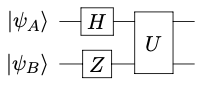
Mathematically, the circuit is represented as:
$ U(H\otimes Z) (\ket{\psi_A} \otimes \ket{\psi_B}) = U ( H\ket{\psi_A} \otimes Z\ket{\psi_B})$
(By convention, the ordering of the basis states, $\ket{00}, \ket{01}, \ket{10}, \ket{11}$ are counting up in binary)
The tensor product $\ket{\psi_1} \otimes \ket{\psi_2} = (a \ket{0} + b\ket{1}) \otimes (c \ket{0} + d\ket{1}) = ac \ket{00} + ad\ket{01} + bc \ket{10} + bd\ket{01}$.
In matrix notation, $\ket{\psi_1} \otimes \ket{\psi_2} \doteq \begin{pmatrix} a \\ b \end{pmatrix} \otimes \begin{pmatrix} c\\d\end{pmatrix} =\begin{pmatrix} ac\\ ad\\ bc\\ bd \end{pmatrix}$
This can be summarized by a simple computational trick:
$\begin{pmatrix} a \\ b \end{pmatrix} \otimes \begin{pmatrix} c\\d\end{pmatrix} =\begin{pmatrix} a\begin{pmatrix}c\\d \end{pmatrix} \\ b \begin{pmatrix}c\\d \end{pmatrix} \end{pmatrix} = \begin{pmatrix} ac\\ ad\\ bc\\ bd \end{pmatrix}$
$= \begin{pmatrix} a_{11}b_{11} & a_{11}b_{12} &a_{12}b_{11} &a_{12}b_{12} \\ a_{11}b_{21} & a_{11}b_{22} &a_{12}b_{21} &a_{12}b_{22}\\ a_{21}b_{11} & a_{21}b_{12} &a_{22}b_{11} &a_{22}b_{12}\\ a_{21}b_{21} & a_{21}b_{22} &a_{22}b_{21} &a_{22}b_{22} \end{pmatrix}$
Downloadable materials:
- Activity: Tensor Products (2)

- Instructor's Guide
- Clicker questions
- Warm-up (pre-test) for Tensor Products
Online tutorial:
We have developed a series of online tutorials that students can complete in class (alone or in groups) or at home. These materials are hosted on our website. To get a course page where you can access student completion information, email us at hello[at]acephysics[dot]net.
CNOT and Entanglement
Content: An introduction to the controlled-NOT (CNOT) gate and the related concept of entanglement.
Prerequisite knowledge: Students should be familiar with quantum states, basic single-qubit gates and circuit diagram conventions, and the tensor product. (i.e., The previous sections on this page.)
Faculty notes: Content to get started and tips for teaching.
Two (or more) particle quantum systems can exhibit interesting correlations (entanglement) stronger than any classical system.
A state is entangled when it cannot be written as a single tensor product of two single-qubit states.
For example, consider the state $\tfrac{1}{\sqrt{2}}(\ket{00} + \ket{01})$. This state is NOT entangled, because we can 'factor' it into $\ket{0} \otimes \tfrac{1}{\sqrt{2}}(\ket{0} + \ket{1})$. In this case the first qubit is in the state $\ket{0}$ and the second state is in the state $\tfrac{1}{\sqrt{2}}(\ket{0} + \ket{1})$.
In contract, we can look at the entangled state $\tfrac{1}{\sqrt{2}}(\ket{00} + \ket{11})$. There is no way to write a ket for the first or second qubit on their own. The state must be written together.
Note: It is possible to describe the first qubit using a reduced density operator. The state of the first qubit would be the completely mixed state $\rho_1 = \frac{1}{2}\mqty( 1 & 0 \\ 0 & 1)$.
Second note: Entanglement has some interesting properties and consequences. We won't get into them in this module, but more information can be found in module "Entanglement and EPR".
In order to have a quantum computer, we need gates that act not only on one qubit, but gates that work on multiple qubits. More specifically, we need gates that will "entangle" two qubits. The most common gate of this type is called the CNOT, or controlled-NOT gate. It does exactly as the name suggests: performs a NOT gate controlled by another qubit. The following is the circuit diagram for a CNOT gate:
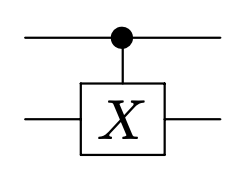
The solid black dot on the top 'wire' indicates that this is the control qubit. The gate on the second qubit will be performed only if the control qubit is a 1. (This has interesting effects for superposition states, as we see in the clicker questions below!)
We can define how the CNOT gate acts on the four 2-qubit computational basis states:
$$ CNOT\ket{00} = \ket{00} \;\;\;\; CNOT\ket{01} = \ket{01}$$
$$ CNOT\ket{10} = \ket{11} \;\;\;\; CNOT\ket{11} = \ket{10}$$
We can use the CNOT to entangle two independent qubits as in the circuit in the clicker question example below.
Downloadable materials:
- Activity: CNOT and Entanglement (3)
- Instructor's Guide
- Clicker questions
- Warm-up (pre-test) for CNOT and Entanglement
Online tutorial:
We have developed a series of online tutorials that students can complete in class (alone or in groups) or at home. These materials are hosted on our website. To get a course page where you can access student completion information, email us at hello[at]acephysics[dot]net.
Quantum Cryptography (BB84)
Content: This activity takes students through the BB84 quantum key distribution protocol. It uses quantum circuit notation and includes the effect of an eavesdropper.
Prerequisite knowledge: Basic single qubit gates (in particular, the Hadamard, H gate). Students should know how to predict probabilistic outcomes of measurements in the computational (Z) basis on superpositions of $|0\rangle, |1\rangle, |+\rangle, |-\rangle$ states.
Notes for faculty: Content to get started and tips for teaching.
The one-time pad is a perfectly secure way to encrypt information. In this protocol, both parties must share a secret key. The one-time pad security relies on the fact that this key is truly secret (no one else has access to it) and that it is only used a single time (hence the name ``one-time''). The secret key must be at least as long as the message (no portion of the key should be repeated).
If Alice wishes to send a message to Bob, Alice will take the message and add the secret key to obtain the cyphertext (the encoded message). In the case of a binary message and a binary key, this would be addition mod 2.
$ \text{message} \oplus \text{key} = \text{cyphertext} $
In mod 2, Bob will just need to do $\text{cyphertext} \oplus \text{ key} = \text{message}$ to decode the cyphertext.
We will often do examples using the english alphabet, in which the addition will be modulo 26. In this case, to decode the cyphertext you will need to ${\it subtract}$ the key (mod 26) to obtain the message.
In all QKD protocols, it is an important assumption that an eavesdropper cannot copy (or clone) an unknown quantum state. The proof (by contradiction) is relatively straightforward:
Assume you have a 'cloning machine'. Such a machine would take an unknown state $\ket{\psi}$ and a blank state (let's call it $\ket{b}$) and turn it into two copies of $\ket{\psi}$. Mathematically, we write it as: $U_{clone} (\ket{\psi} \otimes \ket{b}) = \ket{\psi} \otimes \ket{\psi} $
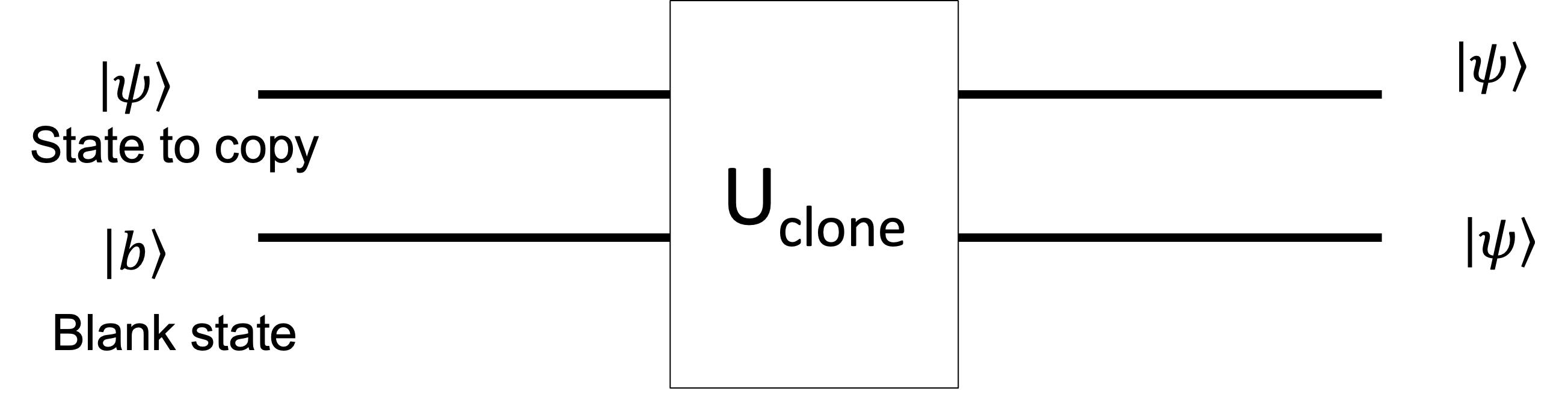
Since we want to be able to clone an arbitrary state, the cloning machine should also work if we input the state $\ket{\phi}$: $U_{clone} (\ket{\phi} \otimes \ket{b}) = \ket{\phi} \otimes \ket{\phi} $
We want to take the inner product of the two equations:
$$ [ ( \bra{\psi} \otimes \ket{b} ) U_{clone}^\dagger ] [U_{clone} ( \ket{\psi} \otimes \ket{b} ) ] = [ \bra{\phi} \otimes \bra{\phi} ] [ \ket{\psi} \otimes \ket{\psi} ] \label{cloneeqn}$$
- $U_{clone}^\dagger U_{clone} = 1$ since $U$ is unitary
- Make sure to take the inner product of qubit 1 (from eqn 1) with qubit 1 (from eqn 2) and then for qubit 2 (from eqn 1) with qubit 2 (from eqn 2)
Then we have that:
$ \ip{\phi}{\psi} \ip{b}{b} = \ip{\phi}{\psi} \ip{\phi}{\psi} $
$ \ip{\phi}{\psi} = \ip{\phi}{\psi}^2$
This is only true if $\ip{\phi}{\psi}$ is equal to 1 or 0. Meaning the cloning machine will only work for states that are identical or orthogonal. In other words, you can build a cloning machine, but it will only clone a set of basis states, not an arbitrary superposition of those basis states.
This is one of the more common QKD protocols and is perfect for use in intro quantum mechanics classes as it only requires knowledge of two-level superposition states and the results of measurements.
In our example, we will use spin-1/2 particles, and we will discuss measurements of spin in the $x$ and $z$ directions.
Players:
Alice - Wants to share a secret key with Bob. She sends qubits to Bob, randomizing what she ends.
Bob - Wants to share a secret key with Alice. Bob receives the qubits sent by Alice and will measure them in a randomly chosen basis.
Eve - An eavesdropper who wants to gain information about the secret key without being detected. She will intercept the qubits that Alice sends to Bob and make measurements before sending the qubit on to Bob.
The Protocol: The following steps can be recorded in the handout (available for download below).
- Alice sends qubits to Bob in either the X or the Z basis. She randomly sends one of
$ \ket{\psi_{0z}}=\ket{0} \;\;\quad \quad \ket{\psi_{0x}}= \ket{+} = \frac{1}{\sqrt{2}}(\ket{0} + \ket{1}) $
$ \ket{\psi_{1z}}=\ket{1} \;\;\quad \quad \ket{\psi_{1x}}= \ket{-} = \frac{1}{\sqrt{2}}(\ket{0} - \ket{1}) $
Alice records the basis she sent (X or Z) and whether she sent the (0 or 1) for each basis. The sequence of 0s and 1s will turn into the secret key. - Bob receives the qubits and makes a measurement. He randomly chooses to measure in either the Z or the X basis and records the results (0 or 1) and the basis he chose (X or Z).
- Alice and Bob reveal the basis they sent or measured. They do this publically. They will throw away all elements of their key (the 0s and 1s) where their basis choice did not match.
- Test for an eavesdropper: Once Alice and Bob have the remaining key, it should match perfectly. The only reason their keys might differ is if there was an eavesdropper messing things up or if there was some decoherence in their qubit channel. They select a portion of their key to compare publically (they will then need to throw away these elements of the key as they are no longer secret). If that portion of their keys is identical, they can feel confident that the rest of their key also matches. If their keys are not identical, they do not have confidence in the rest of their key and will abandon the protocol and start again.
In reality, anything can happen to the qubit as it travels from Alice to Bob. We are going to assume the worst: that a very powerful and quantum-savvy enemy has intercepted the qubit and knows enough of the protocol to make the best measurements they can before sending the qubit to Bob.
Here is the best that an eavesdropper can do:
- Measure the intercepted qubit in either the X or Z basis. Record everything.
- Send the resulting qubit to Bob.
You can follow along in the handout to see the repercussions of this interception. In short:
- Eve will randomly pick the "right" basis to measure in 50% of the time. When she does this, the state she sends to Bob will be unchanged from what Alice sent. In these instances, she is undetectable.
- The other 50% of the time, Eve will select the "wrong" basis (the basis that is opposite to what Alice sent). In these instances, by chance, Eve will get the same key value as Alice 50% of the time and get an opposing value 50% of the time.
- Altogether, Eve has a 25% chance of messing up each qubit that gets sent to Bob.
If Alice and Bob did not test for the presence of an eavesdropper, even with an error rate of 25%, Eve would certainly gain valuable information if Alice and Bob tried to use their "secret" key to encode a message.
Downloadable materials:
- Activity: Cryptography (4)
- Instructor's Guide
- Warm-up (pre-test) for Cryptography
Online tutorial:
We have developed a series of online tutorials that students can complete in class (alone or in groups) or at home. These materials are hosted on our website. To get a course page where you can access student completion information, email us at hello[at]acephysics[dot]net.
 Frequently Asked Questions
How do I implement the tutorial worksheets in my class?
- Tutorials are interactive worksheets that students work through in small groups in class.
- Instructors move between groups and ask prompting questions. They aim to minimize direct instruction and allow the students to work together to explore ideas.
- Ideally, there is a student-instructor ratio of about 12:1 or 15:1 (e.g., 24-30 students with 2 instructors, including TAs/LAs), but tutorials can still be used in a class of more students with an experienced instructor.
- Each worksheet is designed to take about 50 minutes, but timing may vary depending on your context and student population.
Can I edit the materials to make them better fit my course?
Yes, please edit the materials. We do not intend for the materials to be used wholly as written. Rather, they form a complete set that a faculty member can pick and choose from as it fits their schedule, the material already taught, and the interests of both the faculty member and student.
What if I need help implementing active learning in my class?
Physport.org has some short guides to help you facilitate in-class tutorials, as well as to help you implement clicker questions in lectures effectively.
Is there research published about using these materials?
Yes, our AJP paper gives more information on how we implement these types of materials in our upper-division classes.
Who we are
We are PER research faculty teaching at very different institutions - different in class sizes and setups, student demographics, institutional research-focus - but all interested in helping introduce undergraduates to basic elements of Quantum Information Science. We have all taught a variety of quantum courses for many years.
The materials you will find here are not meant to be taken as givens, this is not a "fixed curriculum" that you are supposed to fully adopt (or reject). We hope that you will be inspired by some of the activities, notes, concept-tests, homeworks and more, and will borrow and adapt them for your own situation and students. We do not all use exactly the same materials ourselves.
We have borrowed where we can from PER literature on Quantum Mechanics (and tried - but apologize up front where we occasionally have failed - to appropriately credit the the hard development work of others!) We do not claim that these materials are "Research-validated" (they are still under development), but cheerfully present sometimes half-baked or partially-tested materials that we might argue are "research-based", a vaguer but perhaps more realistic description.
We welcome feedback and suggestions. If you make significant changes or additions, and particularly if you have classroom evidence that suggests it works well - let us know. We hope someday this site will be flexible enough to allow for community-sharing of new resources, and will work towards making that happen. (See contact information below.)
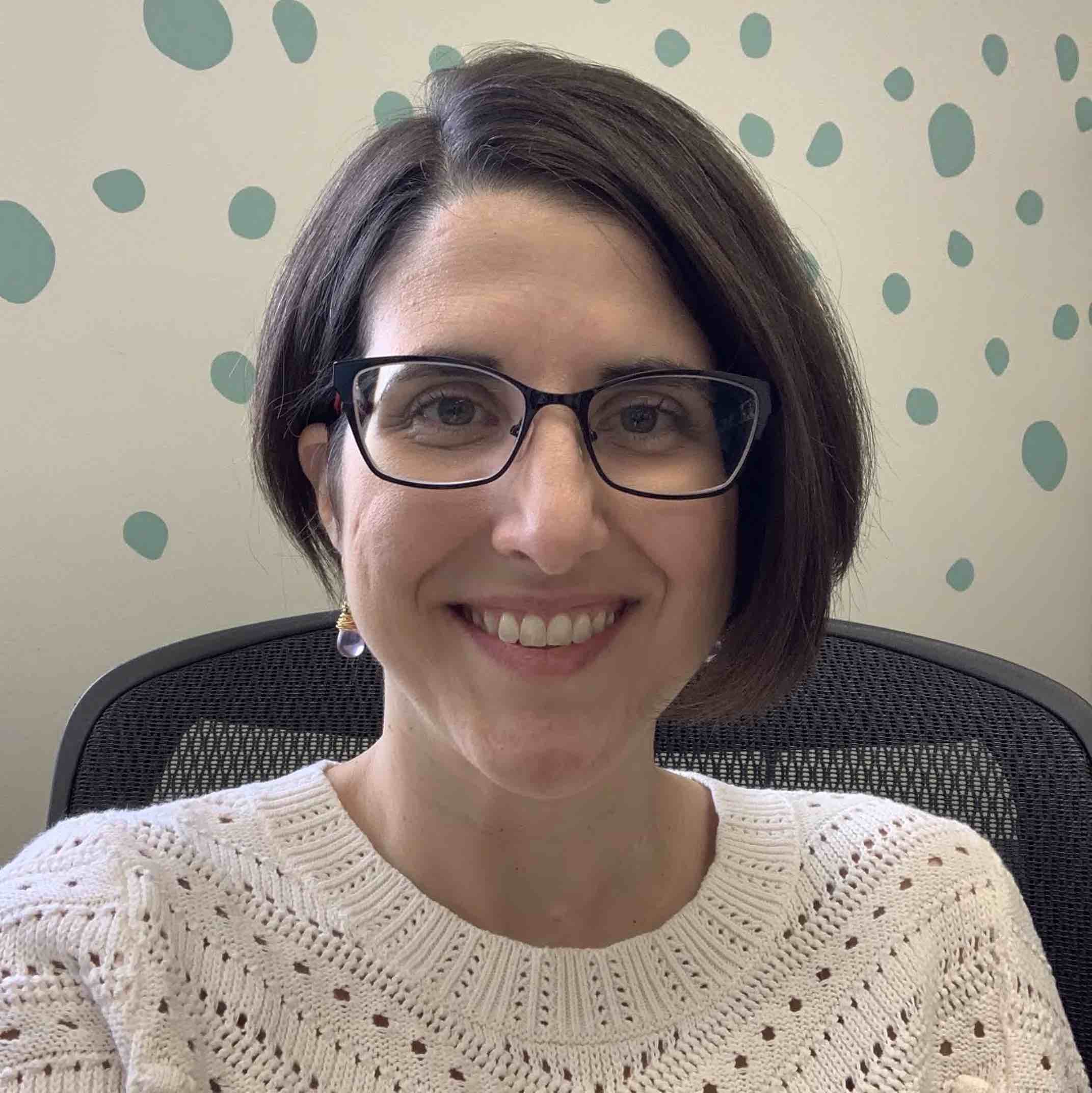 |
Gina Passante is Associate Professor of Physics and Director of the Catalyst Center for the Advancement of Research in Teaching and Learning Math and Science at Cal State University Fullerton. She received her Ph.D. in quantum computing at U. Waterloo before transitioning to PER. |
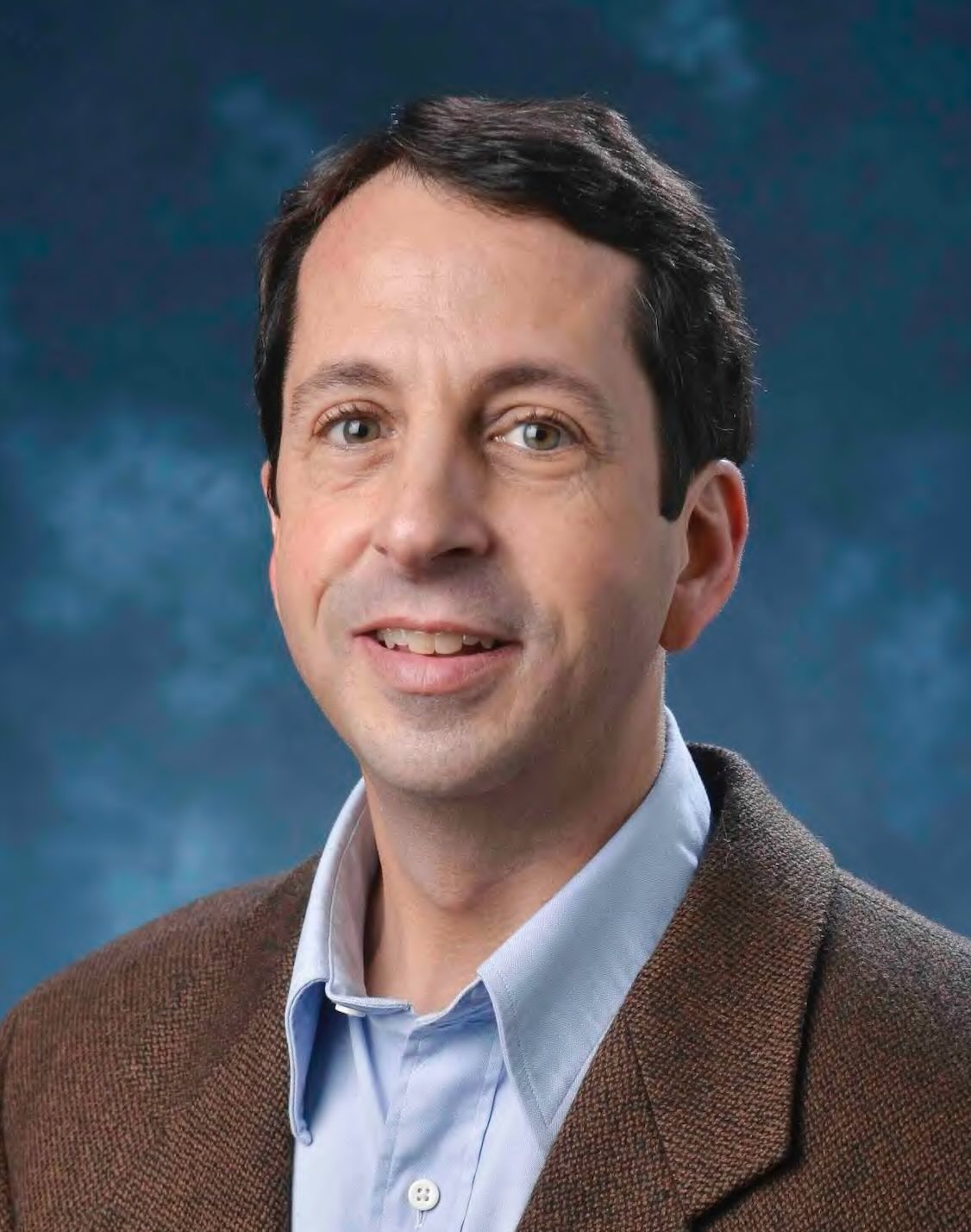 |
Steve Pollock is a Physics professor at CU Boulder who has engaged in PER for 20+ years. He has a background in theoretical nuclear physics. He is an APS Fellow, and was named US Professor of the Year in 2013. His PER work is focused on assessment and curricular materials development in upper-division physics courses. Please email if you are interested in teaching materials for other courses (including middle division Classical Mechanics, E&M, and others). He can be reached at Steven.Pollock (at) Colorado.edu |
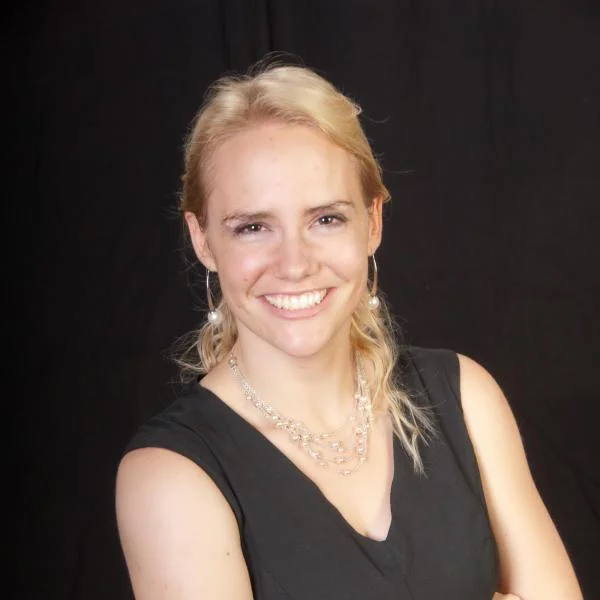 |
Bethany Wilcox is a Physics professor at CU Boulder. Her PER work focuses on the development of research-based and validated assessments of student learning that can be used to measure the impact of curricular changes or compare student learning across courses and institutions. In particular, she is utilizing advanced testing theories to explore viable options for creating modular assessments that can address variations in content coverage in across courses. |
We acknowledge the hard work of our students, including Josephine Meyer (University of Colorado Boulder), Jonan-Rohi Plueger (University of Colorado Boulder), and Bianca Cervantes (former California State University, Fullerton).
We are funded in part by NSF DUE- 2012147 and 2011958: Collaborative Research: Connecting Spins-First Quantum Mechanics Instruction to Quantum Information Science
PLEASE USE AND ADAPT whatever is helpful to you, however it will most benefit your students. Please credit our work if you share your materials beyond your own classes. Please make an effort to keep assessment materials off the open web - alter questions for your students.