

Developed by Alessio Marzari, Stefano Oss, Pasquale Onorato, Massimiliano Malgieri, Andrea Zamboni
| Purpose | To diagnose and analyze undergraduate university students' conceptual difficulties and alternative conceptions regarding Reference Frames, the Galilean Principle of Relativity, and the Equivalence Principle in classical mechanics. |
|---|---|
| Format | Pre/post, Multiple-choice |
| Duration | N/A min |
| Focus | Mechanics Content knowledge (classical relativity) |
| Level | Intermediate, Intro college, High school |
 Login or Register to Download
Downloads are restricted to high school and college faculty.
Login or Register to Download
Downloads are restricted to high school and college faculty.
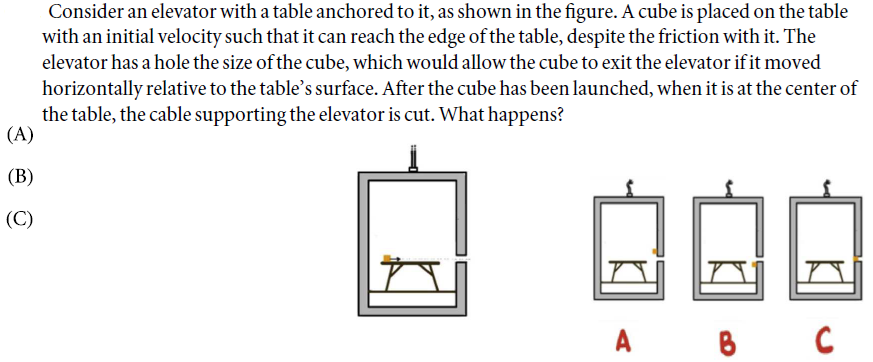
Example question from the CRCI:

CRCI Implementation and Troubleshooting Guide
Everything you need to know about implementing the CRCI in your class.
Login or register to download the implementation guide.
more details
 Silver Validation
This is the second highest level of research validation, corresponding to at least 5 of the validation categories below.
Research Validation Summary
Based on Research Into:
- Student thinking
Studied Using:
- Student interviews
- Expert review
- Appropriate statistical analysis
Research Conducted:
- At multiple institutions
- By multiple research groups
- Peer-reviewed publication
The evaluation of the Classical Relativity Concept Inventory (CRCI) demonstrates that the instrument possesses robust psychometric properties, with an average difficulty index of 0.61, a strong Kuder-Richardson internal consistency reliability (KR-20) of 0.78, and high overall discriminatory power (Ferguson’s delta of 0.97). While statistical analysis confirms the tool is well-calibrated for testing the general student population, it also highlights an operational gap in distinguishing top-performing students due to a shortage of high-difficulty items. Conceptually, the research reveals that while undergraduate physics students exhibit a solid foundational grasp of general reference systems, they encounter persistent, deep-seated difficulties when analyzing motion across non-inertial frames or under the influence of fictitious forces. Specifically, significant cognitive hurdles were identified in tasks requiring students to mentally visualize trajectories from shifting perspectives, accurately apply the weak Principle of Equivalence, and interpret complex acceleration scenarios, such as pendulum behavior or fluid mechanics on inclined planes.
References
- A. Zamboni, A. Marzari, M. Malgieri, P. Onorato, and S. Oss, A diagnostic multiple-choice questionnaire on student misconceptions about relativity in classical mechanics, Eur. J. Phys. 47 (1), 015708 (2026).
We don't have any translations of this assessment yet.
If you know of a translation that we don't have yet, or if you would like to translate this assessment, please contact us!
| Typical Results |
|---|
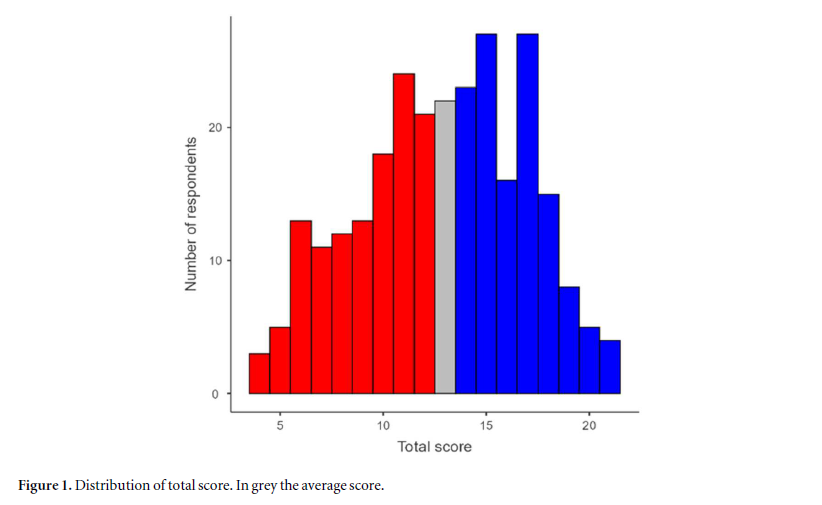
When administered to a sample of 267 physics undergraduate students, the assessment showed an average total score of 12.9 out of 21 (corresponding to 61.4%), with a standard deviation of 4.0. Full details on the score distribution and validation metrics are available in Zamboni et al. 2026.
|
The latest version of the CRCI, released in 2025, is version 1.