

Developed by Eliane Merki, Andreas Lichtenberger, Sarah Hofer, Andreas Vaterlaus
| Purpose | To assess students’ ability to interpret position–time graphs of uniform linear motion when transforming between different frames of reference according to Galilean transformations. |
|---|---|
| Format | Pre/post, Multiple-choice |
| Duration | 20 min |
| Focus | Mechanics Content knowledge (kinematics) |
| Level | Intro college, High school |
 Login or Register to Download
Downloads are restricted to high school and college faculty.
Login or Register to Download
Downloads are restricted to high school and college faculty.
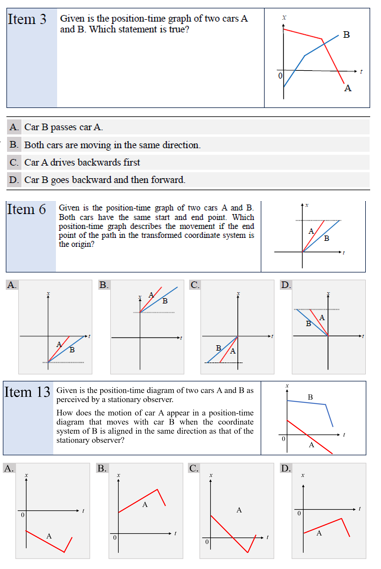
Example questions from the IGT:

IGT Implementation and Troubleshooting Guide
Everything you need to know about implementing the IGT in your class.
Login or register to download the implementation guide.
more details
 Bronze Validation
This is the third highest level of research validation, corresponding to at least 3 of the validation categories below.
Research Validation Summary
Based on Research Into:
- Student thinking
Studied Using:
- Student interviews
- Expert review
- Appropriate statistical analysis
Research Conducted:
- At multiple institutions
- By multiple research groups
- Peer-reviewed publication
The IGT demonstrated satisfactory psychometric properties in a sample of 326 Swiss upper-secondary students. The mean item difficulty (0.55), discrimination index (0.42), and point-biserial coefficient (0.43) were within the desired ranges, and Ferguson’s delta (0.96) indicated strong overall discriminatory power. Confirmatory factor analysis supported the intended three-factor structure corresponding to the three types of Galilean transformations, while Rasch analysis confirmed the expected progression in item difficulty from identity transformations (T1) to transformations between stationary frames (T2) and transformations to a moving frame (T3). The analysis of distractors revealed several alternative conceptions, including difficulties distinguishing overtaking from crossing, translating coordinate systems in the correct direction, and interpreting changes in position–time graphs when transforming to a moving frame of reference. Item 15 showed inadequate discrimination and point-biserial correlation and was therefore recommended for removal, resulting in the 14-item IGT14 version.
References
- E. Merki, S. Hofer, A. Vaterlaus, and A. Lichtenberger, Inventory of Galilean Transformation of uniform linear motion in position-time graphs, Phys. Rev. Phys. Educ. Res. 21 (2), 020118 (2025).
PhysPort provides translations of assessments as a service to our users, but does not endorse the accuracy or validity of translations. Assessments validated for one language and culture may not be valid for other languages and cultures.
| Language | Translator(s) | |
|---|---|---|
| German |  |
If you know of a translation that we don't have yet, or if you would like to translate this assessment, please contact us!
| Typical Results |
|---|
|
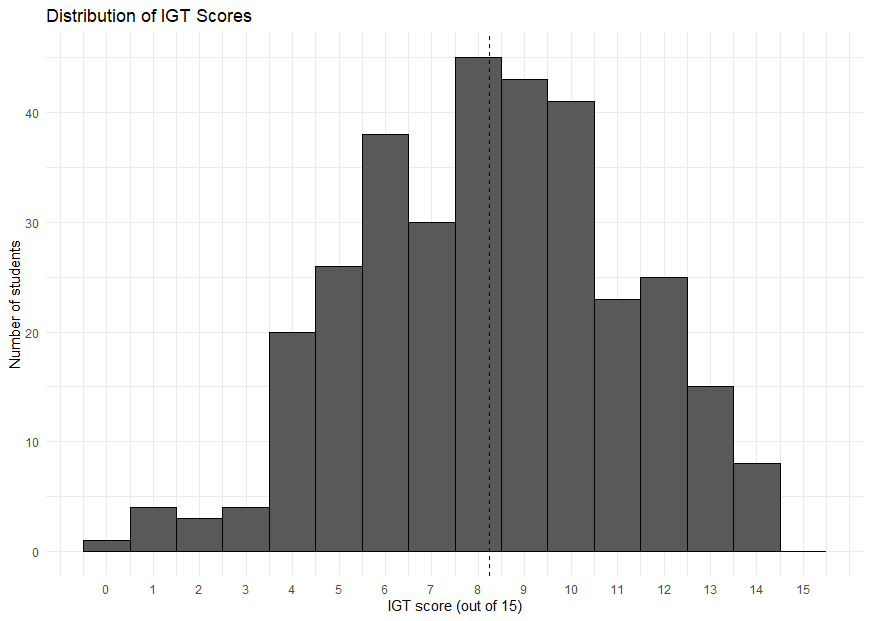 In the validation study, 326 Swiss upper-secondary students completed the 15-item IGT, achieving a mean score of 8.24 out of 15 (SD = 2.86). These scores were obtained from students in the advanced track of upper secondary school, primarily after a brief introduction to frames of reference and a 15-minute predict–observe–explain sequence on Galilean transformations.
The original IGT consists of 15 multiple-choice items. The recommended version, IGT14, was released in 2025 and contains 14 items, omitting the final item of the original IGT. The IGT14 is the version recommended for use because its psychometric properties were within the desired ranges for item difficulty, discrimination, and point-biserial correlation.